
How the Iran war could hit your electricity bill this winter

Uncertainty has again descended over global energy markets. Not only have oil routes been disrupted by the Iran war, so too have some of the world’s most important natural gas supply chains.
This is consequential for Australia as a major liquefied natural gas exporter and because gas plays a pivotal role in our own domestic energy system, especially in winter. If it continues, this distant war may ripple into the Australian grid.
The most immediate shock has come from Qatar, where production at the giant Ras Laffan LNG complex was forced to halt following attacks on key facilities.
Ras Laffan is the world’s largest LNG facility and accounts for roughly 20 per cent of global supply, so its disruption is highly significant.
Typically, about 70 per cent to 80 per cent of Qatar’s LNG exports flow to Asian markets, including major importers such as China, Japan, India and South Korea.
With a substantial portion of this supply now offline, buyers across Asia are scrambling to secure replacement cargo, constricting the LNG market and placing upward pressure on prices.
This disruption puts Australia in a critical position. Australia is one of the world’s largest LNG exporters and supplies roughly 20 per cent of the LNG in key Asian markets. With Qatari supply disrupted, Australian cargoes become one of the closest and most reliable alternatives for Asian buyers.
But Australia’s role as a global LNG exporter also ties our domestic energy markets to international gas prices. When Asian LNG prices rise, the incentive to export Australian gas increases, which in turn can push domestic gas prices higher.
This dynamic is particularly important in Australia’s east, where gas-fired generators directly supply electricity into Australia’s main power market, the National Electricity Market.
While Australia’s eastern gas markets, national grid, and the Asian LNG market operate somewhat independently during stable market conditions, global disruptions like the current conflict can tighten these connections and cause international volatility to be felt domestically.
Since the grid operates on what’s known as “marginal pricing”, the last and most expensive generator needed to meet demand sets the price for the entire region, so even small volumes of gas generation can determine electricity prices – something that becomes especially evident during winter peaks.
The bridge between global LNG markets and the grid largely runs through Queensland. The state hosts the three LNG export terminals at Gladstone, connecting east coast gas production directly to international buyers.
When Asian LNG prices rise, the opportunity cost of supplying gas domestically rises along with it, pushing local prices closer to export price parity.
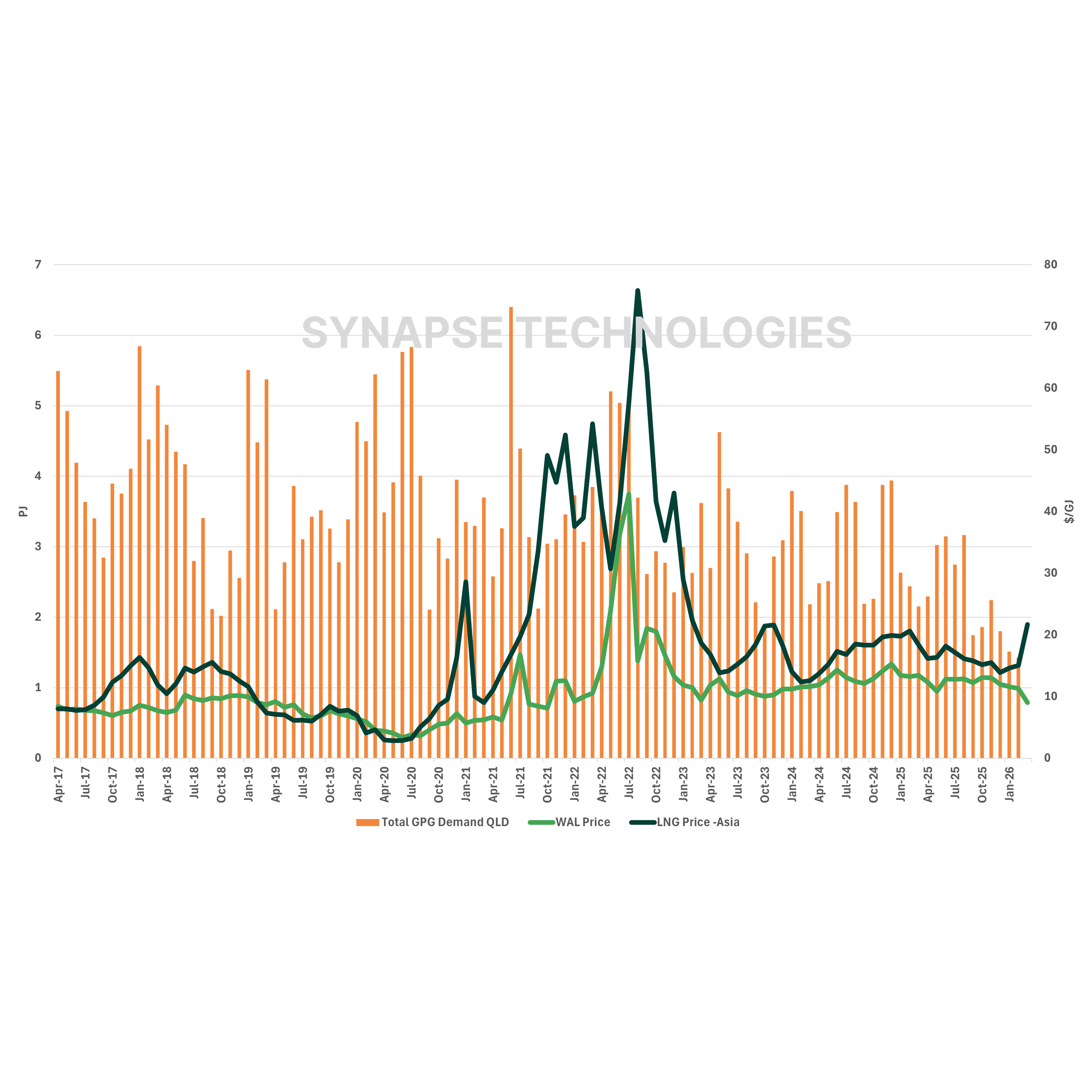
This chart illustrates this relationship by plotting monthly gas consumption at gas-fired generators in Queensland between 2017 and 2026 alongside gas price averages in Asian markets and from the state’s key gas supply hub, Wallumbilla.
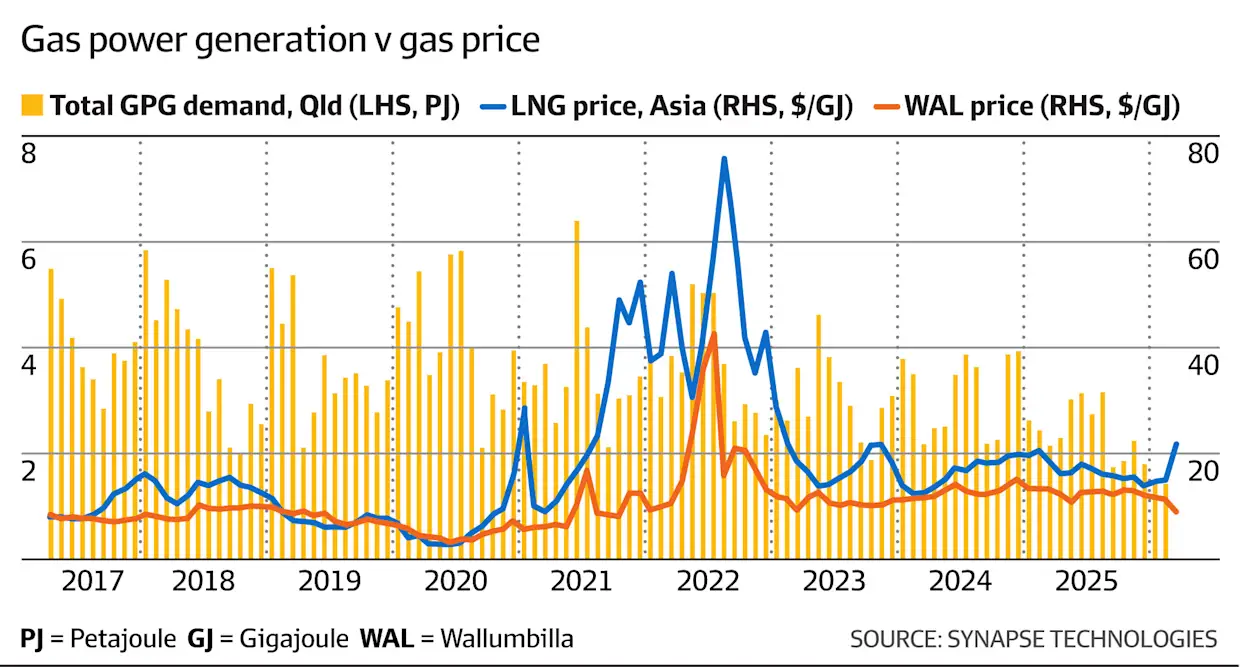
What the chart does clearly highlight is the importance of seasonality. Gas for power generation and heating tends to increase in winter.
When the weather gets colder, electricity demand rises (as does gas demand for heating), while renewable output, particularly solar, tends to be lower.
This seasonal dynamic is an important part of understanding how global gas shocks translate into the Australian grid. A useful example is the global energy crisis that followed the start of the Russia-Ukraine war in February 2022.
While international gas prices surged almost immediately, the most visible impact on Australia’s gas and electricity markets occurred the following winter.
During that winter (which had quite a cold start), energy prices in Queensland rose sharply, with average gas and power prices reaching highs of $42 per gigajoule (July) and $400 per megawatt-hour (June), respectively – the highest average monthly price in a decade for both markets.
Evening power peak prices that June also averaged a staggering $976 per megawatt-hour. Admittedly, outages to coal units at the Callide and Gladstone power stations also contributed to the price hikes over that period.
Interestingly, this new war erupted at the same time of year as the Russia-Ukraine war. The Wallumbilla gas price has not shown any bullishness despite the Asian LNG price already rising; an eerily similar reaction to February 2022. Is it a sign of things to come this winter?
If the current conflict persists and LNG supply disruptions continue, global gas prices could remain elevated for an extended period.
With a major supplier like Qatar offline and Asian buyers competing for replacement cargo, Australia’s LNG exporters will face strong incentives to supply international markets.
Under these conditions, Australian gas prices could approach – perhaps even surpass – the levels of winter 2022, when east coast gas prices averaged $35 per gigajoule and wholesale electricity markets experienced significant volatility.
Gas generators play a specific and important role in Queensland. Although gas accounts for only 6 per cent to 11 per cent of total electricity generation in Queensland, it provides flexible capacity that can respond quickly, especially in the evening peak when the sun sets and demand spikes.
Gas generation tends to ramp during morning and evening demand peaks.
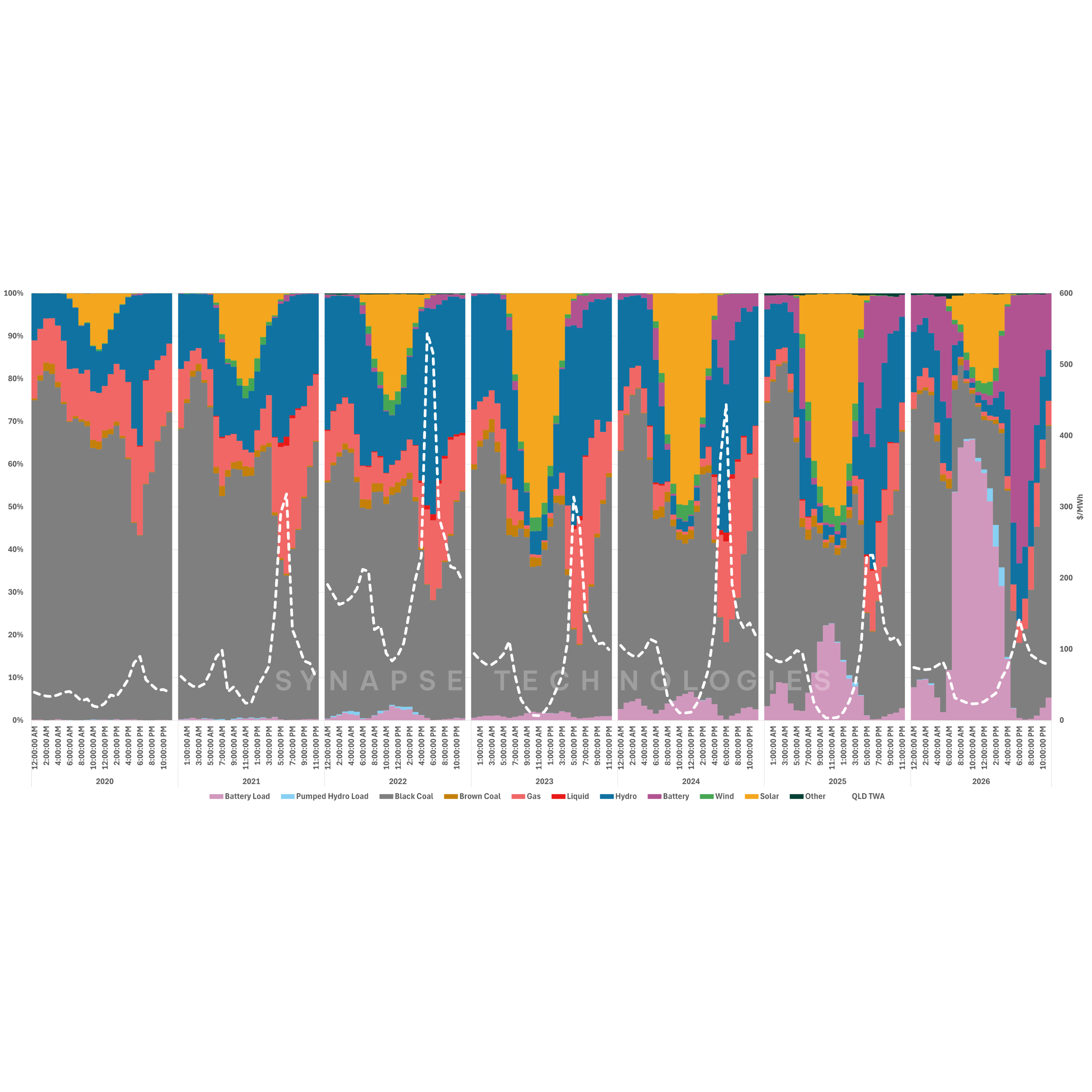
On average, gas generation increases from roughly 117 megawatts during midday periods to about 1.1 gigawatts (2025 average) during evening peaks – a 10-fold ramp within five hours. This enormous swing is primarily caused by rooftop and grid-scale solar displacing gas during the day – in 2017, gas was only doing a 1.5-times ramp.
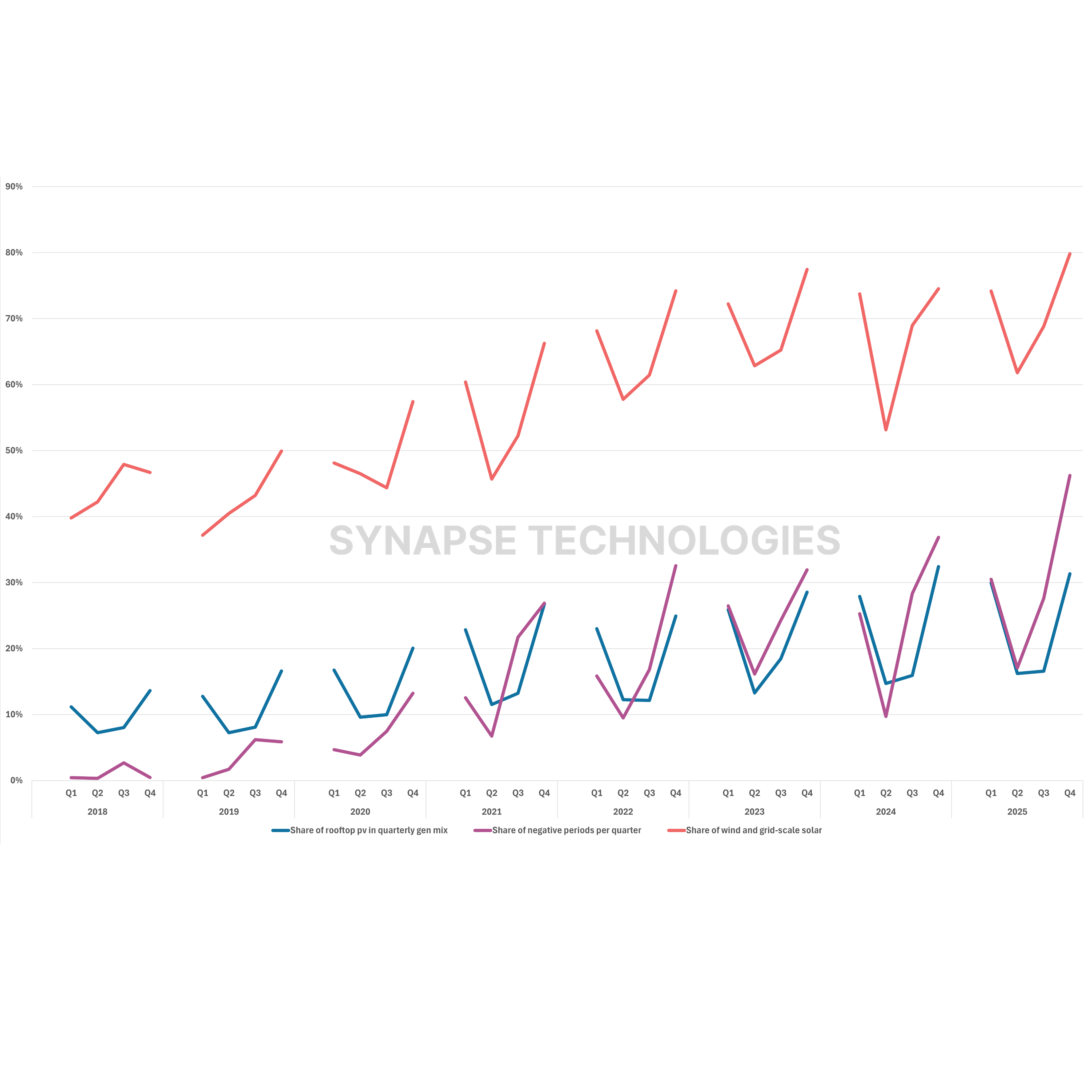
This growth in rooftop and grid solar has also had a significant effect on intraday power price volatility over the last decade.
Origin Energy sits at an interesting junction within this market structure. The company owns the 644-megawatt Darling Downs Power Station in Queensland and also holds a 27.5 per cent stake in the Australia Pacific LNG project at Curtis Island.
APLNG operates two LNG trains, primarily supplying Asian markets. Origin also operates upstream gas fields and the main gas transmission pipeline to the Curtis Island liquefaction facility.
The real test may come if the conflict persists into Australia’s winter. With global LNG prices likely to remain elevated during this period, pressure on east-coast gas markets would intensify.
In that scenario, the ripple effects of a distant war may not remain confined to global commodity markets.
Instead, they could travel through the interconnected chain linking Asian LNG markets, Queensland gas supply and the grid, ultimately shaping electricity prices much closer to home.
The federal government is developing a domestic gas reservation policy which is expected to come into effect in 2027.
It appears gas producers will be required to set aside 15 per cent to 25 per cent of extracted gas for domestic consumption. How effective will such schemes be at buffering the nation from international gas price pressures, especially in prolonged supply crises?
Only time will tell.




How the Iran war could hit your electricity bill this winter
Uncertainty has again descended over global energy markets. Not only have oil routes been disrupted by the Iran war, so too have some of the world’s most important natural gas supply chains.
This is consequential for Australia as a major liquefied natural gas exporter and because gas plays a pivotal role in our own domestic energy system, especially in winter. If it continues, this distant war may ripple into the Australian grid.
The most immediate shock has come from Qatar, where production at the giant Ras Laffan LNG complex was forced to halt following attacks on key facilities.
Ras Laffan is the world’s largest LNG facility and accounts for roughly 20 per cent of global supply, so its disruption is highly significant.
Typically, about 70 per cent to 80 per cent of Qatar’s LNG exports flow to Asian markets, including major importers such as China, Japan, India and South Korea.
With a substantial portion of this supply now offline, buyers across Asia are scrambling to secure replacement cargo, constricting the LNG market and placing upward pressure on prices.
This disruption puts Australia in a critical position. Australia is one of the world’s largest LNG exporters and supplies roughly 20 per cent of the LNG in key Asian markets. With Qatari supply disrupted, Australian cargoes become one of the closest and most reliable alternatives for Asian buyers.
But Australia’s role as a global LNG exporter also ties our domestic energy markets to international gas prices. When Asian LNG prices rise, the incentive to export Australian gas increases, which in turn can push domestic gas prices higher.
This dynamic is particularly important in Australia’s east, where gas-fired generators directly supply electricity into Australia’s main power market, the National Electricity Market.
While Australia’s eastern gas markets, national grid, and the Asian LNG market operate somewhat independently during stable market conditions, global disruptions like the current conflict can tighten these connections and cause international volatility to be felt domestically.
Since the grid operates on what’s known as “marginal pricing”, the last and most expensive generator needed to meet demand sets the price for the entire region, so even small volumes of gas generation can determine electricity prices – something that becomes especially evident during winter peaks.
The bridge between global LNG markets and the grid largely runs through Queensland. The state hosts the three LNG export terminals at Gladstone, connecting east coast gas production directly to international buyers.
When Asian LNG prices rise, the opportunity cost of supplying gas domestically rises along with it, pushing local prices closer to export price parity.
This chart illustrates this relationship by plotting monthly gas consumption at gas-fired generators in Queensland between 2017 and 2026 alongside gas price averages in Asian markets and from the state’s key gas supply hub, Wallumbilla.
What the chart does clearly highlight is the importance of seasonality. Gas for power generation and heating tends to increase in winter.
When the weather gets colder, electricity demand rises (as does gas demand for heating), while renewable output, particularly solar, tends to be lower.
This seasonal dynamic is an important part of understanding how global gas shocks translate into the Australian grid. A useful example is the global energy crisis that followed the start of the Russia-Ukraine war in February 2022.
While international gas prices surged almost immediately, the most visible impact on Australia’s gas and electricity markets occurred the following winter.
During that winter (which had quite a cold start), energy prices in Queensland rose sharply, with average gas and power prices reaching highs of $42 per gigajoule (July) and $400 per megawatt-hour (June), respectively – the highest average monthly price in a decade for both markets.
Evening power peak prices that June also averaged a staggering $976 per megawatt-hour. Admittedly, outages to coal units at the Callide and Gladstone power stations also contributed to the price hikes over that period.
Interestingly, this new war erupted at the same time of year as the Russia-Ukraine war. The Wallumbilla gas price has not shown any bullishness despite the Asian LNG price already rising; an eerily similar reaction to February 2022. Is it a sign of things to come this winter?
If the current conflict persists and LNG supply disruptions continue, global gas prices could remain elevated for an extended period.
With a major supplier like Qatar offline and Asian buyers competing for replacement cargo, Australia’s LNG exporters will face strong incentives to supply international markets.
Under these conditions, Australian gas prices could approach – perhaps even surpass – the levels of winter 2022, when east coast gas prices averaged $35 per gigajoule and wholesale electricity markets experienced significant volatility.
Gas generators play a specific and important role in Queensland. Although gas accounts for only 6 per cent to 11 per cent of total electricity generation in Queensland, it provides flexible capacity that can respond quickly, especially in the evening peak when the sun sets and demand spikes.
Gas generation tends to ramp during morning and evening demand peaks.
On average, gas generation increases from roughly 117 megawatts during midday periods to about 1.1 gigawatts (2025 average) during evening peaks – a 10-fold ramp within five hours. This enormous swing is primarily caused by rooftop and grid-scale solar displacing gas during the day – in 2017, gas was only doing a 1.5-times ramp.
This growth in rooftop and grid solar has also had a significant effect on intraday power price volatility over the last decade.
Origin Energy sits at an interesting junction within this market structure. The company owns the 644-megawatt Darling Downs Power Station in Queensland and also holds a 27.5 per cent stake in the Australia Pacific LNG project at Curtis Island.
APLNG operates two LNG trains, primarily supplying Asian markets. Origin also operates upstream gas fields and the main gas transmission pipeline to the Curtis Island liquefaction facility.
The real test may come if the conflict persists into Australia’s winter. With global LNG prices likely to remain elevated during this period, pressure on east-coast gas markets would intensify.
In that scenario, the ripple effects of a distant war may not remain confined to global commodity markets.
Instead, they could travel through the interconnected chain linking Asian LNG markets, Queensland gas supply and the grid, ultimately shaping electricity prices much closer to home.
The federal government is developing a domestic gas reservation policy which is expected to come into effect in 2027.
It appears gas producers will be required to set aside 15 per cent to 25 per cent of extracted gas for domestic consumption. How effective will such schemes be at buffering the nation from international gas price pressures, especially in prolonged supply crises?
Only time will tell.

How the Iran war could hit your electricity bill this winter
Uncertainty has again descended over global energy markets. Not only have oil routes been disrupted by the Iran war, so too have some of the world’s most important natural gas supply chains.
This is consequential for Australia as a major liquefied natural gas exporter and because gas plays a pivotal role in our own domestic energy system, especially in winter. If it continues, this distant war may ripple into the Australian grid.
The most immediate shock has come from Qatar, where production at the giant Ras Laffan LNG complex was forced to halt following attacks on key facilities.
Ras Laffan is the world’s largest LNG facility and accounts for roughly 20 per cent of global supply, so its disruption is highly significant.
Typically, about 70 per cent to 80 per cent of Qatar’s LNG exports flow to Asian markets, including major importers such as China, Japan, India and South Korea.
With a substantial portion of this supply now offline, buyers across Asia are scrambling to secure replacement cargo, constricting the LNG market and placing upward pressure on prices.
This disruption puts Australia in a critical position. Australia is one of the world’s largest LNG exporters and supplies roughly 20 per cent of the LNG in key Asian markets. With Qatari supply disrupted, Australian cargoes become one of the closest and most reliable alternatives for Asian buyers.
But Australia’s role as a global LNG exporter also ties our domestic energy markets to international gas prices. When Asian LNG prices rise, the incentive to export Australian gas increases, which in turn can push domestic gas prices higher.
This dynamic is particularly important in Australia’s east, where gas-fired generators directly supply electricity into Australia’s main power market, the National Electricity Market.
While Australia’s eastern gas markets, national grid, and the Asian LNG market operate somewhat independently during stable market conditions, global disruptions like the current conflict can tighten these connections and cause international volatility to be felt domestically.
Since the grid operates on what’s known as “marginal pricing”, the last and most expensive generator needed to meet demand sets the price for the entire region, so even small volumes of gas generation can determine electricity prices – something that becomes especially evident during winter peaks.
The bridge between global LNG markets and the grid largely runs through Queensland. The state hosts the three LNG export terminals at Gladstone, connecting east coast gas production directly to international buyers.
When Asian LNG prices rise, the opportunity cost of supplying gas domestically rises along with it, pushing local prices closer to export price parity.
This chart illustrates this relationship by plotting monthly gas consumption at gas-fired generators in Queensland between 2017 and 2026 alongside gas price averages in Asian markets and from the state’s key gas supply hub, Wallumbilla.
What the chart does clearly highlight is the importance of seasonality. Gas for power generation and heating tends to increase in winter.
When the weather gets colder, electricity demand rises (as does gas demand for heating), while renewable output, particularly solar, tends to be lower.
This seasonal dynamic is an important part of understanding how global gas shocks translate into the Australian grid. A useful example is the global energy crisis that followed the start of the Russia-Ukraine war in February 2022.
While international gas prices surged almost immediately, the most visible impact on Australia’s gas and electricity markets occurred the following winter.
During that winter (which had quite a cold start), energy prices in Queensland rose sharply, with average gas and power prices reaching highs of $42 per gigajoule (July) and $400 per megawatt-hour (June), respectively – the highest average monthly price in a decade for both markets.
Evening power peak prices that June also averaged a staggering $976 per megawatt-hour. Admittedly, outages to coal units at the Callide and Gladstone power stations also contributed to the price hikes over that period.
Interestingly, this new war erupted at the same time of year as the Russia-Ukraine war. The Wallumbilla gas price has not shown any bullishness despite the Asian LNG price already rising; an eerily similar reaction to February 2022. Is it a sign of things to come this winter?
If the current conflict persists and LNG supply disruptions continue, global gas prices could remain elevated for an extended period.
With a major supplier like Qatar offline and Asian buyers competing for replacement cargo, Australia’s LNG exporters will face strong incentives to supply international markets.
Under these conditions, Australian gas prices could approach – perhaps even surpass – the levels of winter 2022, when east coast gas prices averaged $35 per gigajoule and wholesale electricity markets experienced significant volatility.
Gas generators play a specific and important role in Queensland. Although gas accounts for only 6 per cent to 11 per cent of total electricity generation in Queensland, it provides flexible capacity that can respond quickly, especially in the evening peak when the sun sets and demand spikes.
Gas generation tends to ramp during morning and evening demand peaks.
On average, gas generation increases from roughly 117 megawatts during midday periods to about 1.1 gigawatts (2025 average) during evening peaks – a 10-fold ramp within five hours. This enormous swing is primarily caused by rooftop and grid-scale solar displacing gas during the day – in 2017, gas was only doing a 1.5-times ramp.
This growth in rooftop and grid solar has also had a significant effect on intraday power price volatility over the last decade.
Origin Energy sits at an interesting junction within this market structure. The company owns the 644-megawatt Darling Downs Power Station in Queensland and also holds a 27.5 per cent stake in the Australia Pacific LNG project at Curtis Island.
APLNG operates two LNG trains, primarily supplying Asian markets. Origin also operates upstream gas fields and the main gas transmission pipeline to the Curtis Island liquefaction facility.
The real test may come if the conflict persists into Australia’s winter. With global LNG prices likely to remain elevated during this period, pressure on east-coast gas markets would intensify.
In that scenario, the ripple effects of a distant war may not remain confined to global commodity markets.
Instead, they could travel through the interconnected chain linking Asian LNG markets, Queensland gas supply and the grid, ultimately shaping electricity prices much closer to home.
The federal government is developing a domestic gas reservation policy which is expected to come into effect in 2027.
It appears gas producers will be required to set aside 15 per cent to 25 per cent of extracted gas for domestic consumption. How effective will such schemes be at buffering the nation from international gas price pressures, especially in prolonged supply crises?
Only time will tell.
How the Iran war could hit your electricity bill this winter
Uncertainty has again descended over global energy markets. Not only have oil routes been disrupted by the Iran war, so too have some of the world’s most important natural gas supply chains.
This is consequential for Australia as a major liquefied natural gas exporter and because gas plays a pivotal role in our own domestic energy system, especially in winter. If it continues, this distant war may ripple into the Australian grid.
The most immediate shock has come from Qatar, where production at the giant Ras Laffan LNG complex was forced to halt following attacks on key facilities.
Ras Laffan is the world’s largest LNG facility and accounts for roughly 20 per cent of global supply, so its disruption is highly significant.
Typically, about 70 per cent to 80 per cent of Qatar’s LNG exports flow to Asian markets, including major importers such as China, Japan, India and South Korea.
With a substantial portion of this supply now offline, buyers across Asia are scrambling to secure replacement cargo, constricting the LNG market and placing upward pressure on prices.
This disruption puts Australia in a critical position. Australia is one of the world’s largest LNG exporters and supplies roughly 20 per cent of the LNG in key Asian markets. With Qatari supply disrupted, Australian cargoes become one of the closest and most reliable alternatives for Asian buyers.
But Australia’s role as a global LNG exporter also ties our domestic energy markets to international gas prices. When Asian LNG prices rise, the incentive to export Australian gas increases, which in turn can push domestic gas prices higher.
This dynamic is particularly important in Australia’s east, where gas-fired generators directly supply electricity into Australia’s main power market, the National Electricity Market.
While Australia’s eastern gas markets, national grid, and the Asian LNG market operate somewhat independently during stable market conditions, global disruptions like the current conflict can tighten these connections and cause international volatility to be felt domestically.
Since the grid operates on what’s known as “marginal pricing”, the last and most expensive generator needed to meet demand sets the price for the entire region, so even small volumes of gas generation can determine electricity prices – something that becomes especially evident during winter peaks.
The bridge between global LNG markets and the grid largely runs through Queensland. The state hosts the three LNG export terminals at Gladstone, connecting east coast gas production directly to international buyers.
When Asian LNG prices rise, the opportunity cost of supplying gas domestically rises along with it, pushing local prices closer to export price parity.
This chart illustrates this relationship by plotting monthly gas consumption at gas-fired generators in Queensland between 2017 and 2026 alongside gas price averages in Asian markets and from the state’s key gas supply hub, Wallumbilla.
What the chart does clearly highlight is the importance of seasonality. Gas for power generation and heating tends to increase in winter.
When the weather gets colder, electricity demand rises (as does gas demand for heating), while renewable output, particularly solar, tends to be lower.
This seasonal dynamic is an important part of understanding how global gas shocks translate into the Australian grid. A useful example is the global energy crisis that followed the start of the Russia-Ukraine war in February 2022.
While international gas prices surged almost immediately, the most visible impact on Australia’s gas and electricity markets occurred the following winter.
During that winter (which had quite a cold start), energy prices in Queensland rose sharply, with average gas and power prices reaching highs of $42 per gigajoule (July) and $400 per megawatt-hour (June), respectively – the highest average monthly price in a decade for both markets.
Evening power peak prices that June also averaged a staggering $976 per megawatt-hour. Admittedly, outages to coal units at the Callide and Gladstone power stations also contributed to the price hikes over that period.
Interestingly, this new war erupted at the same time of year as the Russia-Ukraine war. The Wallumbilla gas price has not shown any bullishness despite the Asian LNG price already rising; an eerily similar reaction to February 2022. Is it a sign of things to come this winter?
If the current conflict persists and LNG supply disruptions continue, global gas prices could remain elevated for an extended period.
With a major supplier like Qatar offline and Asian buyers competing for replacement cargo, Australia’s LNG exporters will face strong incentives to supply international markets.
Under these conditions, Australian gas prices could approach – perhaps even surpass – the levels of winter 2022, when east coast gas prices averaged $35 per gigajoule and wholesale electricity markets experienced significant volatility.
Gas generators play a specific and important role in Queensland. Although gas accounts for only 6 per cent to 11 per cent of total electricity generation in Queensland, it provides flexible capacity that can respond quickly, especially in the evening peak when the sun sets and demand spikes.
Gas generation tends to ramp during morning and evening demand peaks.
On average, gas generation increases from roughly 117 megawatts during midday periods to about 1.1 gigawatts (2025 average) during evening peaks – a 10-fold ramp within five hours. This enormous swing is primarily caused by rooftop and grid-scale solar displacing gas during the day – in 2017, gas was only doing a 1.5-times ramp.
This growth in rooftop and grid solar has also had a significant effect on intraday power price volatility over the last decade.
Origin Energy sits at an interesting junction within this market structure. The company owns the 644-megawatt Darling Downs Power Station in Queensland and also holds a 27.5 per cent stake in the Australia Pacific LNG project at Curtis Island.
APLNG operates two LNG trains, primarily supplying Asian markets. Origin also operates upstream gas fields and the main gas transmission pipeline to the Curtis Island liquefaction facility.
The real test may come if the conflict persists into Australia’s winter. With global LNG prices likely to remain elevated during this period, pressure on east-coast gas markets would intensify.
In that scenario, the ripple effects of a distant war may not remain confined to global commodity markets.
Instead, they could travel through the interconnected chain linking Asian LNG markets, Queensland gas supply and the grid, ultimately shaping electricity prices much closer to home.
The federal government is developing a domestic gas reservation policy which is expected to come into effect in 2027.
It appears gas producers will be required to set aside 15 per cent to 25 per cent of extracted gas for domestic consumption. How effective will such schemes be at buffering the nation from international gas price pressures, especially in prolonged supply crises?
Only time will tell.
How the Iran war could hit your electricity bill this winter
Uncertainty has again descended over global energy markets. Not only have oil routes been disrupted by the Iran war, so too have some of the world’s most important natural gas supply chains.
This is consequential for Australia as a major liquefied natural gas exporter and because gas plays a pivotal role in our own domestic energy system, especially in winter. If it continues, this distant war may ripple into the Australian grid.
The most immediate shock has come from Qatar, where production at the giant Ras Laffan LNG complex was forced to halt following attacks on key facilities.
Ras Laffan is the world’s largest LNG facility and accounts for roughly 20 per cent of global supply, so its disruption is highly significant.
Typically, about 70 per cent to 80 per cent of Qatar’s LNG exports flow to Asian markets, including major importers such as China, Japan, India and South Korea.
With a substantial portion of this supply now offline, buyers across Asia are scrambling to secure replacement cargo, constricting the LNG market and placing upward pressure on prices.
This disruption puts Australia in a critical position. Australia is one of the world’s largest LNG exporters and supplies roughly 20 per cent of the LNG in key Asian markets. With Qatari supply disrupted, Australian cargoes become one of the closest and most reliable alternatives for Asian buyers.
But Australia’s role as a global LNG exporter also ties our domestic energy markets to international gas prices. When Asian LNG prices rise, the incentive to export Australian gas increases, which in turn can push domestic gas prices higher.
This dynamic is particularly important in Australia’s east, where gas-fired generators directly supply electricity into Australia’s main power market, the National Electricity Market.
While Australia’s eastern gas markets, national grid, and the Asian LNG market operate somewhat independently during stable market conditions, global disruptions like the current conflict can tighten these connections and cause international volatility to be felt domestically.
Since the grid operates on what’s known as “marginal pricing”, the last and most expensive generator needed to meet demand sets the price for the entire region, so even small volumes of gas generation can determine electricity prices – something that becomes especially evident during winter peaks.
The bridge between global LNG markets and the grid largely runs through Queensland. The state hosts the three LNG export terminals at Gladstone, connecting east coast gas production directly to international buyers.
When Asian LNG prices rise, the opportunity cost of supplying gas domestically rises along with it, pushing local prices closer to export price parity.
This chart illustrates this relationship by plotting monthly gas consumption at gas-fired generators in Queensland between 2017 and 2026 alongside gas price averages in Asian markets and from the state’s key gas supply hub, Wallumbilla.
What the chart does clearly highlight is the importance of seasonality. Gas for power generation and heating tends to increase in winter.
When the weather gets colder, electricity demand rises (as does gas demand for heating), while renewable output, particularly solar, tends to be lower.
This seasonal dynamic is an important part of understanding how global gas shocks translate into the Australian grid. A useful example is the global energy crisis that followed the start of the Russia-Ukraine war in February 2022.
While international gas prices surged almost immediately, the most visible impact on Australia’s gas and electricity markets occurred the following winter.
During that winter (which had quite a cold start), energy prices in Queensland rose sharply, with average gas and power prices reaching highs of $42 per gigajoule (July) and $400 per megawatt-hour (June), respectively – the highest average monthly price in a decade for both markets.
Evening power peak prices that June also averaged a staggering $976 per megawatt-hour. Admittedly, outages to coal units at the Callide and Gladstone power stations also contributed to the price hikes over that period.
Interestingly, this new war erupted at the same time of year as the Russia-Ukraine war. The Wallumbilla gas price has not shown any bullishness despite the Asian LNG price already rising; an eerily similar reaction to February 2022. Is it a sign of things to come this winter?
If the current conflict persists and LNG supply disruptions continue, global gas prices could remain elevated for an extended period.
With a major supplier like Qatar offline and Asian buyers competing for replacement cargo, Australia’s LNG exporters will face strong incentives to supply international markets.
Under these conditions, Australian gas prices could approach – perhaps even surpass – the levels of winter 2022, when east coast gas prices averaged $35 per gigajoule and wholesale electricity markets experienced significant volatility.
Gas generators play a specific and important role in Queensland. Although gas accounts for only 6 per cent to 11 per cent of total electricity generation in Queensland, it provides flexible capacity that can respond quickly, especially in the evening peak when the sun sets and demand spikes.
Gas generation tends to ramp during morning and evening demand peaks.
On average, gas generation increases from roughly 117 megawatts during midday periods to about 1.1 gigawatts (2025 average) during evening peaks – a 10-fold ramp within five hours. This enormous swing is primarily caused by rooftop and grid-scale solar displacing gas during the day – in 2017, gas was only doing a 1.5-times ramp.
This growth in rooftop and grid solar has also had a significant effect on intraday power price volatility over the last decade.
Origin Energy sits at an interesting junction within this market structure. The company owns the 644-megawatt Darling Downs Power Station in Queensland and also holds a 27.5 per cent stake in the Australia Pacific LNG project at Curtis Island.
APLNG operates two LNG trains, primarily supplying Asian markets. Origin also operates upstream gas fields and the main gas transmission pipeline to the Curtis Island liquefaction facility.
The real test may come if the conflict persists into Australia’s winter. With global LNG prices likely to remain elevated during this period, pressure on east-coast gas markets would intensify.
In that scenario, the ripple effects of a distant war may not remain confined to global commodity markets.
Instead, they could travel through the interconnected chain linking Asian LNG markets, Queensland gas supply and the grid, ultimately shaping electricity prices much closer to home.
The federal government is developing a domestic gas reservation policy which is expected to come into effect in 2027.
It appears gas producers will be required to set aside 15 per cent to 25 per cent of extracted gas for domestic consumption. How effective will such schemes be at buffering the nation from international gas price pressures, especially in prolonged supply crises?
Only time will tell.





.png)